
Quick Answer
How close to the boundary can an awning be built?
Awnings near boundaries can raise building-line, fire, privacy, access and stormwater questions. The correct answer depends on the site plan, title conditions, local rules and the proposed structure.
For a solution grounded in the actual property, explore approval planning for outdoor structures. A useful project discussion should connect the intended use with dimensions, exposure, structure, drainage, finish and any required approvals.
Building lines, title conditions and shared walls
Start by checking locate cadastral boundaries and applicable building lines. Then consider keep roof runoff on the correct property; together these factors show how the complete installation will perform in its intended position.
Locate cadastral boundaries and applicable building lines
Keep roof runoff on the correct property
Consider maintenance access and neighbouring windows
Confirm whether relaxation or consent is required
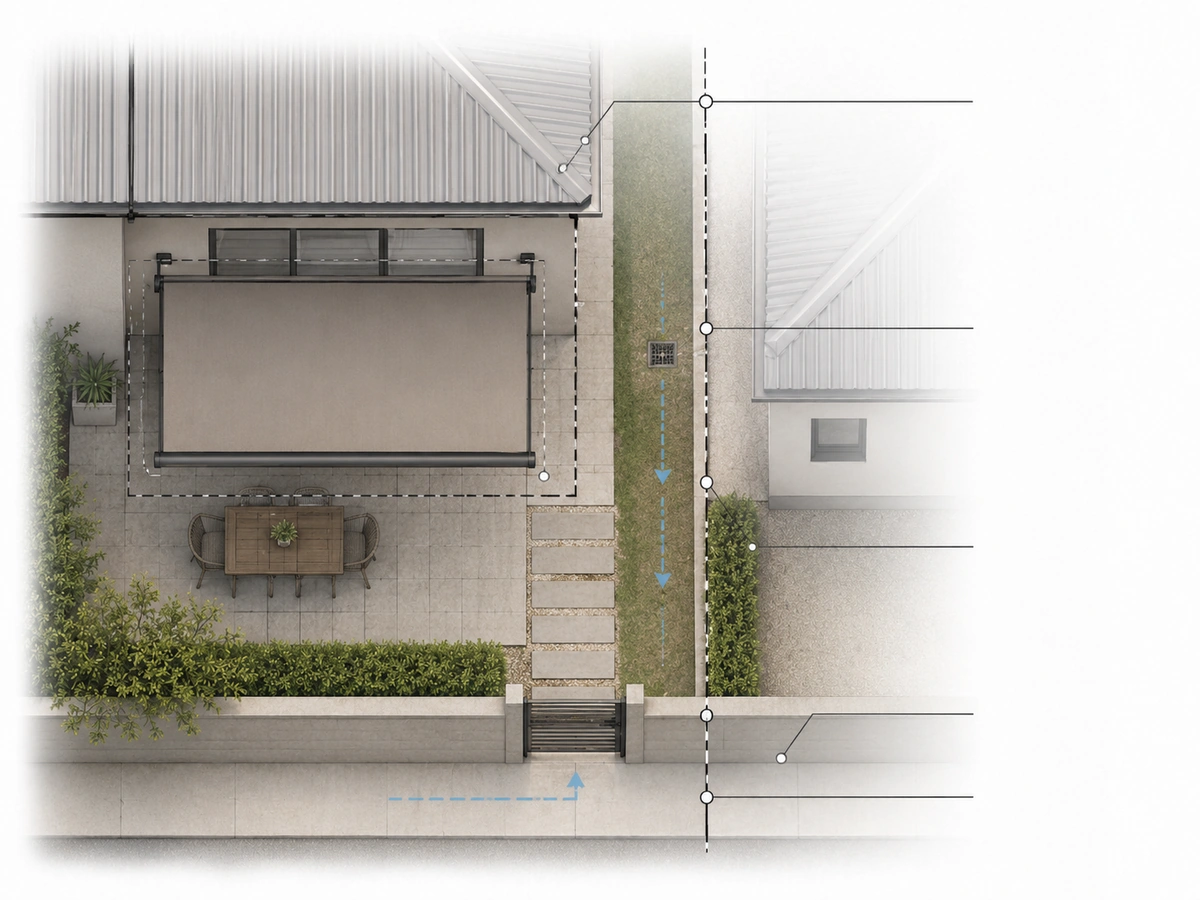
Checking the site plan before you design
Before requesting a quotation, record use approved plans rather than fence positions alone and do not discharge water onto neighbouring property. These topic-specific details make proposals easier to compare and reduce assumptions.
- Use approved plans rather than fence positions alone
- Do not discharge water onto neighbouring property
- Record any formal consent correctly
- Seek professional guidance before building close to a boundary
Confirming the boundary position accurately
Work from the property's site plan or diagram rather than from the position of the existing fence or wall, which does not always sit on the legal boundary. Where a structure would come close to the line, establish the actual boundary position before design, not after the posts are set.
Common Questions
Boundary, Building-Line and Neighbour Considerations FAQ
Does the fence mark the legal boundary?
Not necessarily. Fences and walls are often built near the boundary rather than on it, and the difference can matter when a structure has to sit a set distance back. If the design is tight against the line, confirm the boundary from the site diagram.
Do I need my neighbour's consent?
It depends on the local requirements and how close the structure sits to the line. Some municipalities require written neighbour consent for structures within the building line. Beyond the legal position, telling a neighbour before a large structure appears against a shared wall tends to prevent avoidable disputes.
Can rainwater be discharged towards a neighbouring property?
Concentrating runoff onto adjoining land is a common source of complaints and should be avoided. Plan where a large roof discharges as part of the design, and direct it to a point on your own property.